

23 Oct ACL Injury Prevention for Girls Soccer Players: A PROGRAM that Must Be COACHED, Not Just a Few Exercises from TikTok
I’m sick of social media.
Peruse your feed and you’ll see posts that promise all the quick fixes and play to your insatiable desire for instant gratification. It knows how to deceive you, keep you scrolling, and search for that “thing” to save you.
Your eyes stare at the glowing screen in a trance. You’re sucked in by messaging like “lose weight fast!” or “get clear skin in 7 days!” or “get toned in two weeks!” It gives you shiny promises, but you later find out, there’s no actual and lasting results in the end.
And this isn’t just happening in beauty, health and wellness, but also, the in ACL injury prevention and performance for young girls.
“Here are 2 exercises to prevent ACL tears!” or “prevent injury with this dinky 10 minute warm-up!”
I hate to break it to you, but these are all talk and no walk.
For girls soccer players to truly reduce ACL injuries the best they can, they must follow a quality speed, agility and strength training program, not just a ‘few exercises’ from TikTok.

Controllable Factors of ACL Injuries in Girls Soccer Players
There are a multitude of controllables to prevent ACL injuries in girls soccer players, such as:
1. Proper nutrition
2. Recovery
3. Soccer Load Management
4. Speed, Agility, and Neuromuscular/Strength training
I’m just going to focus on the last one for this article since it’s the lowest hanging fruit everyone should be doing consistently: speed, agility, and neuromuscular/strength training.
Correcting muscle asymmetries, muscle weaknesses, and biomechanical risk factors like knee valgus and trunk swaying, takes time (watch podcast I did with ACL researcher Dr. Tim Hewett HERE). But it’s a non-negotiable in today’s world of youth girls soccer.
With the game becoming more rigorous, girls must put in the time to be resilient to the increasing physicality and fast pasted nature of the game. Too, soccer is now a year-round sport, so all the more reason for young girls players to ensure their bodies are resilient to the volume of trainings and games.
Get your girls soccer players in the gym. And do so year-round. ACLs can be reduced by over 50% if you do this. For my young female athletes who have committed to strength training in the gym year-round with me here in Tampa Florida (1-2x a week), we’ve had no ACL tears.
ACLs can be reduced by over 50% if your girl has this level of commitment, too. You want to throw everything you got it at this.

Why Consistency Matters
If I were to evaluate any youth girls soccer team between the ages of 12-18, I’d see a lot of whacky movement patterns that leave them at risk for ACL injuries. Not enough girls are addressing these and making the time to truly undo these faulty patterns. And these are even worse during a girl’s growth spurt (on average age 12-13) because her body composition is changing with more fat mass in relation to muscle mass, causing her to not control her center of mass as well, and forces in the game going to the ligaments first.
Compared to boys, girls don’t put on muscle as quickly during puberty. But the good news is, if girls train body control and then progress with a consistent strength program, they can balance out these disadvantageous changes during their growth spurts and put themselves in a healthy position the rest of their teenage years.
For starters, most girls at the beginning of puberty and during puberty have excessive knee valgus due to weak glutes, quads, and hamstrings, which causes more rotational torque on the knee when decelerating and planting their foot.
I’ve evaluated hundreds of girls soccer players in my gym in the Tampa Bay area (Lutz, Florida), and this is the one I see the most on day one: the knee caves in during basic squatting and lunging, body weight exercises, so it begs the questions, how awful is this during high speed movements in soccer, where it’s more risky?
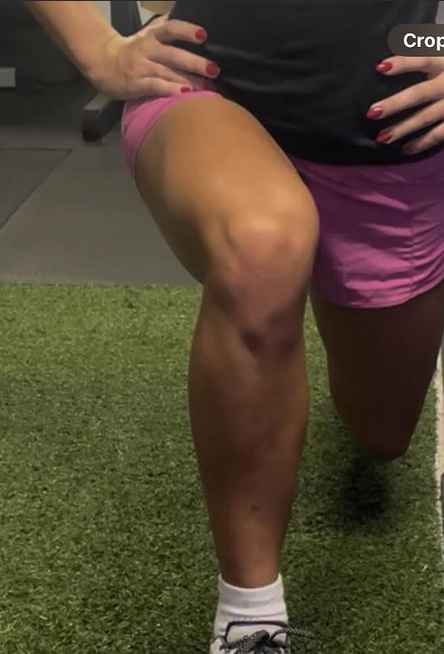

^ knee valgus on day 1 of athlete assessments due to muscle weaknesses and lack of previous neuromuscular/strength training.
Consistent, rigorous training is paramount to correct a movement pattern like this because motor un-learning to takes time, especially for a population that is so focused on soccer specific skill work that actually makes these patterns worse, and certain muscles (quads) are overused all the time.
The second mechanical issue I see, is weak, unstable cores, aka “trunk dominance” in Dr. Tim Hewett’s extensive ACL risk research in female athletes.
This universal weakness could be because coaches program push-ups or crappy planks as punishment, OR they never correct their girls on the awful form they’re doing. Their hips are drooping, or worse yet, their butts are sky high when performing a push-up or plank, which doesn’t fire the core muscles at all. It just makes them weaker.
You want your girls to be lined up, creating tension in their glute muscles when performing push-up and plank variations:

When the core is weak and coaches aren’t correcting girls in these basic plank and pushing movements, girls will sway their trunks during cutting movements in the game, where the shoulders lean towards the plant foot, causing more force on the plant foot ACL. Here is improper, high ACL risk form from the Cutting Movement Assessment Score (CMAS) research paper, notice the trunk and shoulders leaning toward plant foot:

Instead, we want the trunk leaning into the direction of travel:

I’ve found that simply coaching proper form on basic plank movements goes a long way in cleaning this up. We eventually progress to harder core variations like side planks, side plank leg raises, and Copenhagen planks to further challenge the lumbo-pelvic hip complex, and get the hip adductors involved.

Build TRUE Strength
Once these mechanical errors are corrected, which takes weeks, then it is time to load and actually get strong. Which takes even longer.
We want to progress how much weight girls soccer players are lifting gradually and safely. I can’t have a 13-year-old girl come to me for two months in the summer and go from a 65lb to 200lb deadlift in that short period of time because the load spike can cause more harm than good, and a lot of soreness. Girls need to stick with strength training year-round, and progress gradually. This long-term approach allows them to get strong relative to their body weight, which means they’re eventually lifting some heavy loads and crushing it!

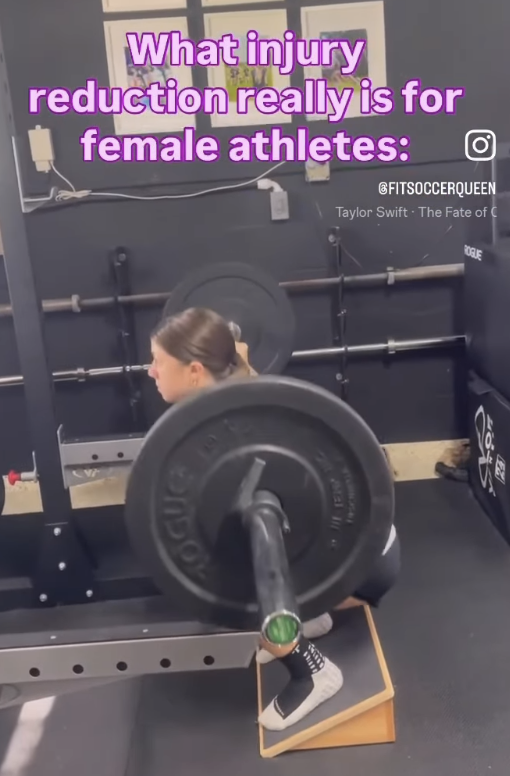
Every girls soccer player should work toward front/back squatting 75% of body weight (butt to heels!), hex bar deadlifting 1.25x body weight, and pistol/single leg squatting to a box 20% of her body weight with pristine form, control on the lowering part, knee NOT wobbling or caving in, chest staying upright and not falling forward.
It takes months to work toward these numbers safely and effectively. It should be gradual. It should be true athletic development – not a quick fix, but a long-term process and program. That’s another thing: it’s a program. So the exercise selection, the dosing (sets/reps), and timing is all key.
Also, picking the correct accessory movements to support the main lifts above is important as well. As an example, to further build the hamstrings for dead lifting, we also do Nordic Ham Curls, slider curls, stability ball curls, and TRX hamstring curls.
I can’t repeat enough that ACL injury prevention is a program, not a few exercises you do here and there.
In Lutz, Florida, I have a handful of girls soccer players who do my speed, strength and agility training year-round, and they stay healthy and thrive! And BECOME MORE CONFIDENT!
Deceleration and Plyometrics Programming
Once girls soccer players have the stability and strength to handle their bodies on firm ground, it’s time to up the ante on deceleration movements and plyometrics. Too often, girls only do the lifting part of a program, and their trainers completely ignore a deceleration and plyometric program. Girls must do these year-round, with a trainer properly periodizing them based on in-season and off-season.
And most critically, a trainer actually teaching these movements. Too often, girls are not taught to get low during decelerating, side shuffling, cutting and changing directing.
When they’re too tall, with their hips high, and knees straight, the forces go straight to the ACL much for a potential rupture. Worse yet, it makes girls slow and less agile!
Girls must drop into their hips when decelerating, cutting, and changing direction for efficient movement and more stability. Make sure this is being taught and CORRECTED!
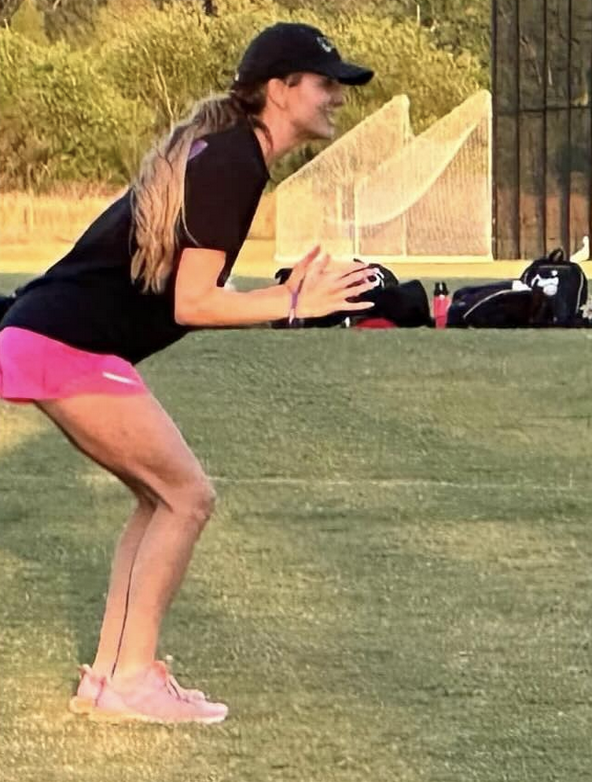
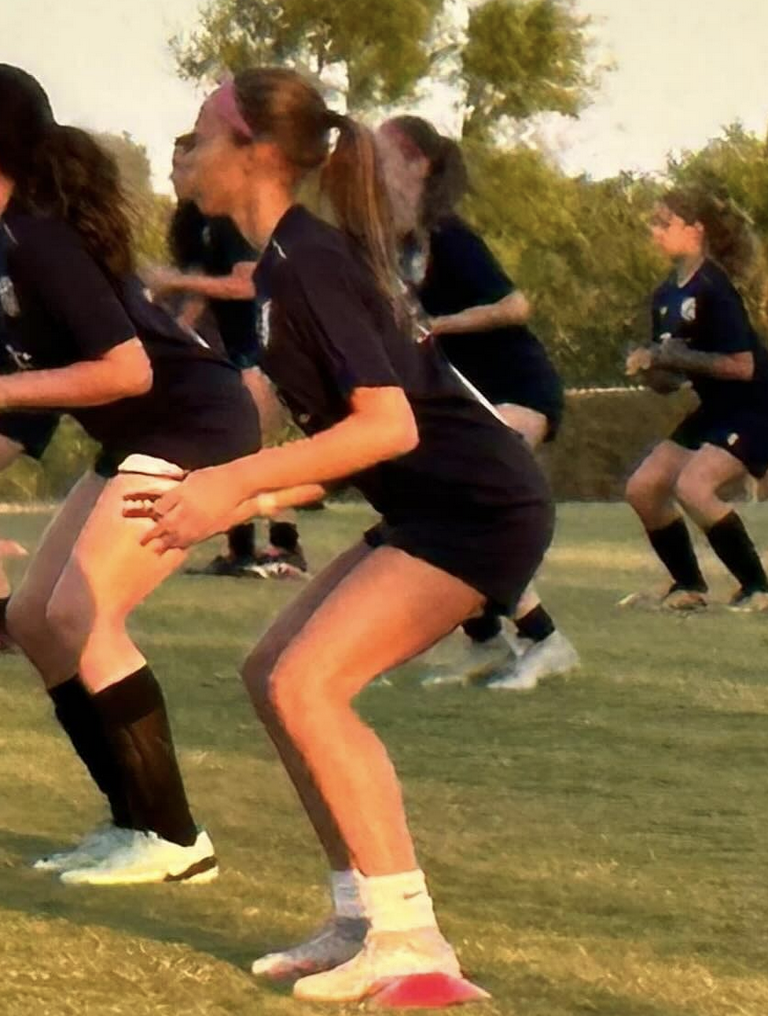
Plyometrics must be progressed slowly too – from low tier, to medium tier, to high tier. Low tier, meaning, the mechanical load on the knee is not too high.
For example, a beginner should never do high tier plyos on day one – aka a 13 year old novice should never do 30″ inch box jumps or broad jumps for distance, until her muscles and tendons have been built up to handle these high mechanical loads. Too, she has to have been taught proper landing technique where her knees aren’t collapsing upon landing, or her trunk and shoulders aren’t falling forward.
When the trunk falls forward upon landing, the mechanical load on the ACL increases. We want the shoulders stacked on top of the ankles when landing a box, depth, or ANY jump:

The girl above worked up to these for several weeks, where I helped her nail down proper positioning on her landings so she was stable for higher depth and box jumps. Now we are doing some crazy jumps! But girls have to earn advanced plyometric drills first, otherwise they put themselves at a higher risk of ACL injury.
This is why when I see very young girls on social media doing plyometrics that are too advanced for them with crappy form, I want to bang my head against a brick wall.
Too often, plyos aren’t taught enough to girls. Coaches just wing them, or try to make them look cool on social media to go viral. They’re using young kids to do wild exercises they aren’t prepared for to become Instagram famous, not taking into account these girls’ long-term knee health.
Positions are key for girls to not hurt their ACLs more: shoulders stacked on top of ankles, sink into hips, hips back, chest up.
Plyometrics must also progress in all planes of motion, where girls aren’t just going forward, but they’re also going backward and sideways, to get to decelerating from all angles.
They also must be done both bilaterally and unilaterally. After all, ACL injuries occur on one leg, so unilateral plyos must be in an injury prevention program:
What All Girls Soccer Players MUST MASTER
For girls to have the BEST chance of reducing ACL injuries they must work toward these YEAR-ROUND:
Dead lifting 1.25x their body weight: strong hamstrings prevent tibia from sheering forward and rupturing ACL during decelerating movements
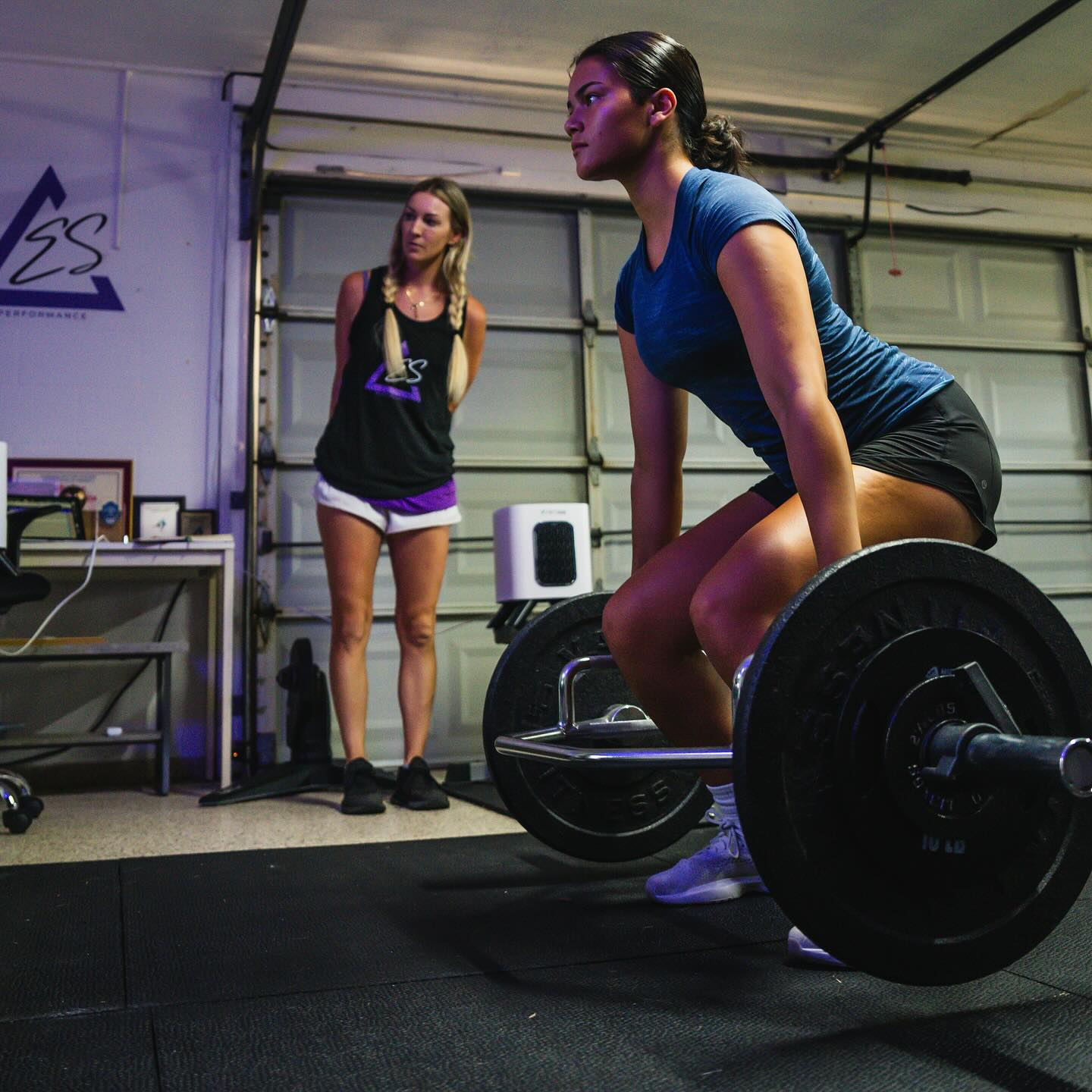
Squatting 75% of their body weight “cheeks to sneaks” full dept (butt to heels): full range squatting increases flexibility and strengthens quadriceps to safeguard the knee
Doing a perfect push-up for 10-15 reps no hips drooping or butt in air: perfect push-ups actually build strong cores that can stabilize during cutting movements
Single Leg Squat 20% of body weight with near perfect form, no knee valgus, with trunk/posture upright and not falling forward
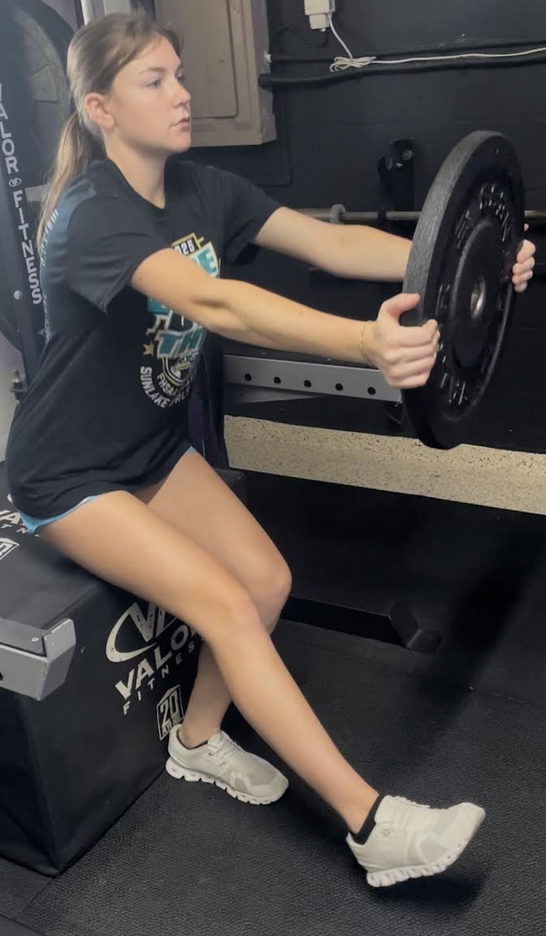
Doing 1 perfect chin-up, no swinging, staying totally straight: a perfect chin-up is a core exercise that also helps with stabilization during cutting movements, and resiliency to tackles/physical contact ACLs.
Performing a Poliquin Step Down for 20 reps with know knee valgus or knee wobbling: strengthens the inner muscle of the quad, the VMO, which stabilizes the knee

Performing a near perfect Nordic Ham Curl where they can go all the way down with good hamstring control
Reactive Strength Index (RSI) over 1.5 for all bilateral plyometric drills, over 1.0 for unilateral drills: a high RSI allows girls so pump the brakes and re-accelerate quickly – it means they can handle high ground reaction forces.
Again, this all takes time. Girls must train these year-round to get to these numbers. If they start at age 11-13, starting with building basic stability and coordination body weight, then progressing to load slowly over time, they’ll be doing things NO ONE ELSE is doing by age 18.
Better yet, they’ll be physically prepared for the demanding D1 college game:
And not only will they be healthy, they will be confident and empowered.
Isn’t that what we ultimately want for our girls soccer players? To blossom into resilient young women for life?
Thought so.
So make sure they STOP scrolling on TikTok, and START committing to a year-round ACL prevention/performance program.
ABOUT THE AUTHOR

Erica Mulholland is a former college 3x All-American soccer player and now Hall of Famer from Johns Hopkins University. She holds a Master of Science in Exercise Science and is a Certified Strength and Conditioning Coach, who has been helping female athletes of all sports with speed, agility, strength, power, and conditioning for over 13 years. She works with athletes who want to become stronger and faster, as well as ACL rehab girls soccer players in the later stages (over 3 month mark post-op) who want to return to sport better than they were prior to injury. Whether you’re a fully healthy athlete who wants to become resilient, or an ACL patient wanting to come back better than ever, Erica is here to help. She does speed, strength and agility training for girls soccer players and all field-based female athletes in her gym in the Tampa and Lutz, Florida.
Work with Erica in Tampa and Lutz and Land O Lakes Florida for speed, agility, and strength training, OR late stage ACL rehab (must be at minimum 3 months into physical therapy and post-surgery): BOOK Assessment
Need more personalized help from Erica? BOOK A CONSULT HERE
Interested in Remote Training for Female Athletes? BOOK A CONSULT HERE
Get Erica’s book FEMALE ATHLETE HIGH PERFORMANCE
Check out her podcast: The Strong Female Athlete
No Comments