

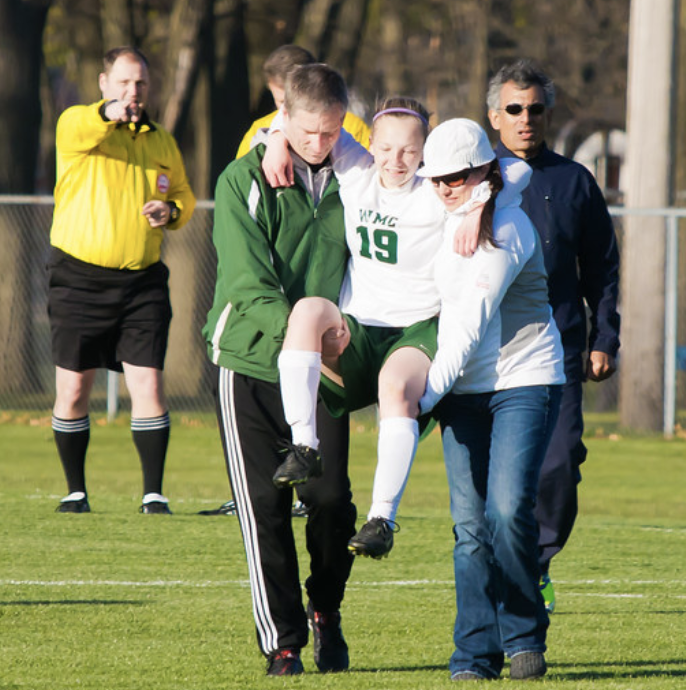
08 Sep ACL Physical Therapy for Girls Soccer Players: Why It’s Not Good Enough and the Re-Tear Rate is So High (PART 2)
This is Part 2 to my multiple part series on acl rehab and physical therapy for girls soccer players.
Let’s do a review of the research I discussed last time: when girls return back sooner than the 9 month post op mark, re-tear risk goes up. When they delay return to sport each month after the 9 month mark, the re-tear rate goes way down. So adding more months for the body to truly prepare for the demands of soccer is always a good idea.
The muscles take time to adapt to strength gains, speed gains, and the motor learning during deceleration movements. Adding on, the brain takes time to adapt to the reactive and chaotic component of the game. The last half of ACL recovery involves training blocks of up to 8 weeks for adaptation to occur and progression to happen safely.
So in summary: don’t rush rehab.
The re-tear rate is the highest it has been due to 1) incomplete physical therapy and 2) poor physical therapy.
Sadly, our young girls soccer players are experiencing both due to a failed medical system. Oftentimes, insurance will only give you a certain quality of a physical therapy (usually poor), or worse yet, insurance runs out at the 3, 6 or 9 month post-op mark, and everyone is left fending for themselves.
ACL reconstruction is a major surgery. And the rehabilitation process is a long one that must be taken seriously, as well as implemented diligently by an experienced practioner (physical therapist and then off to a strength and conditioning professional in the later stages).
At about the 3 month mark when the athlete can perform the movement patterns and begin to jog, and perhaps insurance has run out, they can go off to a qualified strength and conditioning professional/CSCS PT who has practiced return to play and is well versed.
Early Release = High Re-Tear
I am not sure where the love affair with returning to play 9 months post op came from. Maybe it’s because the surgeon said the graft is healed, or maybe insurance runs out and the physical therapist just gives the green light, instead of doing what is right. The pressure from the young girl and her parents is real, too, but a true practioner does the right thing, and doesn’t give into the family’s timelines.
I’ve had parents here in Tampa, Florida say to me, ‘well, we are nearing the 10 month post op mark and she has high school season starting soon.’ They’re wanting me to say she’s cleared, and get on their timeline.
Meanwhile, the girl can’t decelerate in a controlled setting without falling forward and her hips not getting low enough. She’s unbalanced. She still can’t move efficiently in a controlled and supervised setting, which begs the question, how will her mechanics fair in a high speed, chaotic setting like a soccer game? How will her ACL hold up?
Her quadricep still shakes on slow single leg squats, so what will the quad do under forces of up to 8x body weight during a cutting movement?
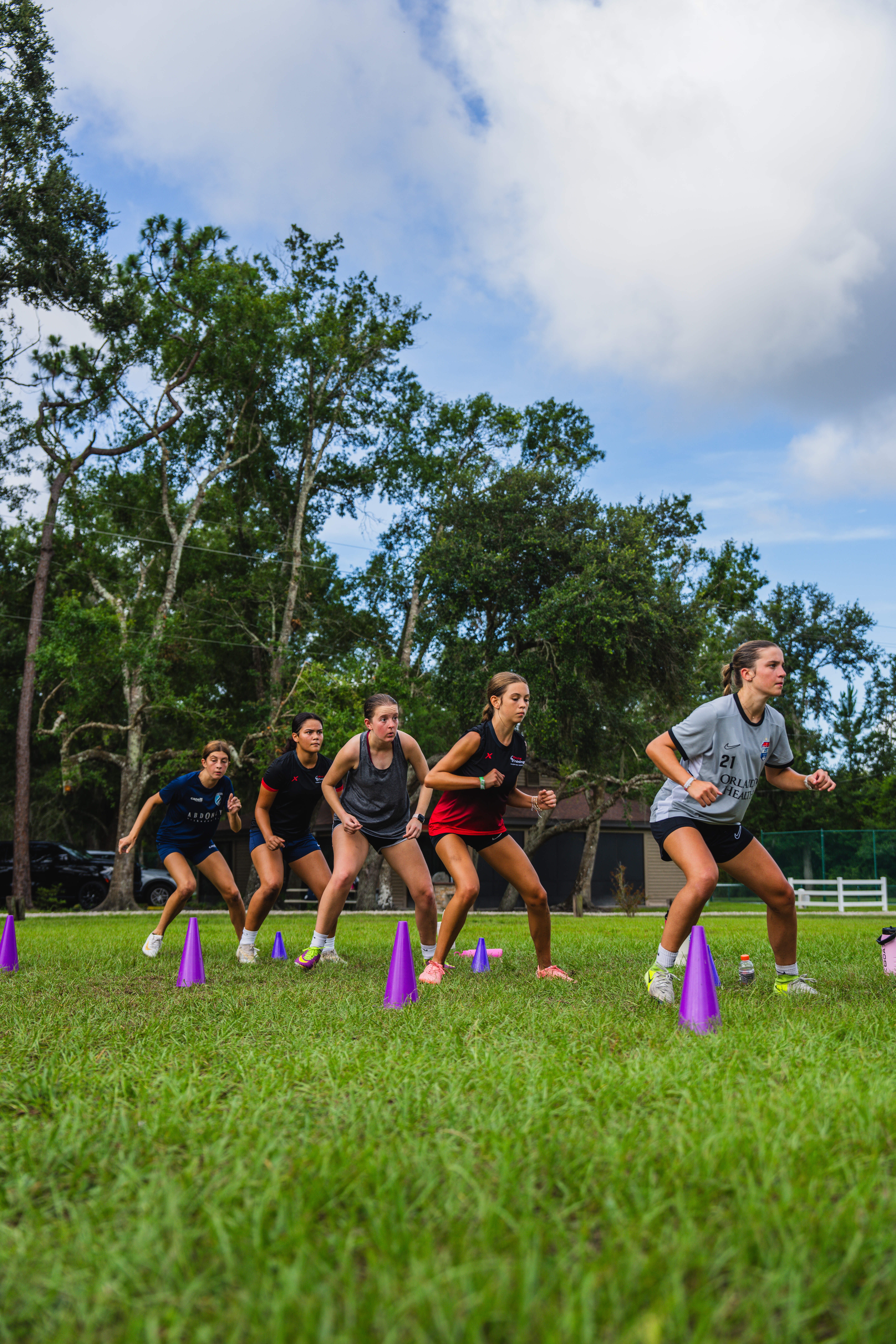
I don’t give into people. I am straight up with my requirements for girls to return to play. And I’m not just trying to get someone cleared – I am wanting them to go back stronger, faster, and better than their healthy teammates.
I have several checkpoints I look at before I know a girl is ready. I’m not using the leg press to judge strength because it’s not functional. There’s no balance component. Rather, I use a single leg squat and split squat test relative to body weight.
I need all these boxes checked and the athlete to feel 11/10 confident with them – plyometrics, strength, deceleration, agility, speed and conditioning.
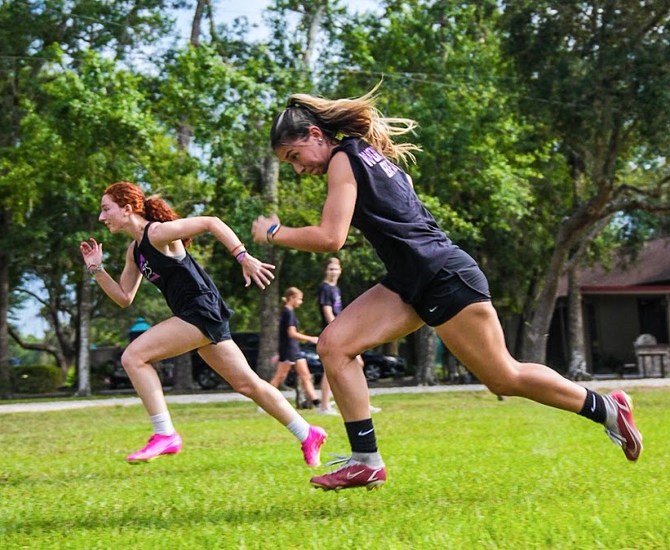
Because this is the game.
We must not simply clear girls soccer players. We must prepare them for battle.
The game is not a 1 rep single leg press. The game is not 3 sets of 10 reps isolated muscle movements. The game is not a few hops in the PT clinic. In fact, 30% of ACL re-tears are due to incomplete plyometric programs and progressions!
Plyometric programs take time (8 week training cycles at a time), starting at light tier then to high tier where girls progress to jumps with higher mechanical loads on the knee.
The game is hundreds of changes of directions, which are movements where ACL tears occur. These movements require proper build up, combined with eccentric strength training in a gym setting.

Adding on, the game demands a high conditioning level, and if the girl is not fit for this, she will fatigue quickly, and fatigue causes the muscles to breakdown, no longer protecting the knee joint.
So if you’re a parent of a young girl soccer player reading this and she’s a few months into her ACL physical therapy, make sure it’s preparing her for the rigorous and violent movements in the game. Please, as you get closer to the 3-6 month post op mark, find a strength and conditioning professional who is certified and who can get your daughter back to the field better than ever.
Ride the rehab process out fully. Because I can promise you, you don’t want to see her go through this again.
ABOUT THE AUTHOR

Erica Mulholland is a former college 3x All-American soccer player and now Hall of Famer from Johns Hopkins University. She holds a Master of Science in Exercise Science and is a Certified Strength and Conditioning Coach, who has been helping female athletes of all sports with speed, agility, strength, power, and conditioning for over 13 years. She works with athletes who want to become stronger and faster, as well as ACL rehab girls soccer players in the later stages (over 3 month mark post-op) who want to return to sport better than they were prior to injury. Whether you’re a fully healthy athlete who wants to become resilient, or an ACL patient wanting to come back better than ever, Erica is here to help. She practices in-person in her gym in Tampa, Florida.
*Train with Erica in Tampa Florida for speed and strength training, OR late stage ACL rehab (must be at minimum 3 months into physical therapy and post ACL surgery): BOOK Assessment
**Need more personalized help from Erica? BOOK A CONSULT HERE
***Interested in Remote Training for Female Athletes? BOOK A CONSULT HERE
Get Erica’s second book FEMALE ATHLETE HIGH PERFORMANCE

Check out her podcast: The Strong Female Athlete
No Comments