
02 Jan Plyometrics for Girls Soccer Players: Why MOST Get it WRONG and How to Truly GET EXPLOSIVE!
If there’s anything you need to know to not butcher your plyometrics, it’s this: SHORT DURATION, MAX EFFORT, LONG REST.
That’s it. I may just end the blog right there.
Kidding.
I’m so incredibly passionate about educating girls soccer players (and parents!) on the correct way to do plyometrics because too many do them wrong.
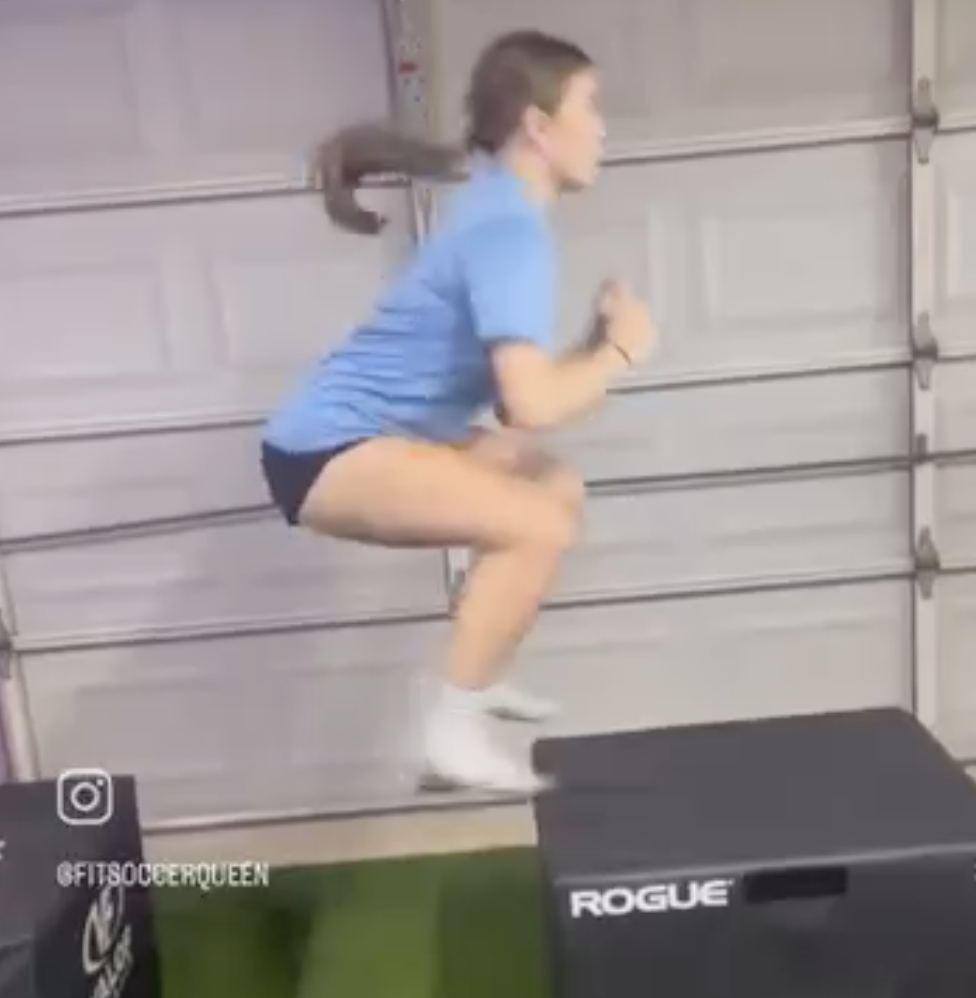
Plyometrics are defined as the ability to shorten the time between the concentric and eccentric muscle action during accelerating and braking. Think deceleration/agility, hops, jumps, and bounds. All of these are explosive movements and must be trained this way.
Plyometrics must be bouncy.
Plyometrics must be explosive.
Plyometrics must be ELECTRIC!
How MOST Fail at Plyos
99% of the plyometrics I see young girls doing on social media are not correct. In fact, they’re the furthest thing from a plyometric you can get LOL.
They’re slow. They’re clunky. They’re NOT twitchy.
Too often, I see girls soccer players do plyos for minutes on end, which causes not only form to break down, but the explosiveness of the exercise to be non-existent.
Worse yet, I see a lot of drills that are circuit style where the girl is bopping from one plyo hop to the next with no rest. The drill lasts well over 10 seconds, which begins to detrain fast twitch muscle fibers.
This is not true plyometric training. Long rest times are required in between short duration sets so girls can go MAX EFFORT and maintain fast ground contact times. I don’t program plyo drills longer than 6-10 seconds.
Ground Contact Time and Reactive Strength Index (RSI)
The first key to plyometric training is ensuring fast ground contacts of your hops, bounds, and leaps for quick force production and to enhance the Stretch Shortening Cycle (SSC). We want elastic athletes!
In fact, speed experts are beginning to say that ground contact time has more impact on how fast an athlete is, more than running mechanics! It makes sense because when you watch the fastest athletes in the world, not all of them have “perfect” sprint mechanics, but they sure are able to generate force and fly down the track with ease. They are BOUNCY!
The second key to plyometric training is something called Reactive Strength Index (RSI) which measures ground contact time compared to jump height. A high RSI signifies elite neuromuscular control, indicating an athlete can quickly transition from eccentric (loading) to concentric (jumping) phases, which improves sprinting, jumping, and cutting.

For a drill like Pogo Hops, young athletes should aim to get an RSI above 1.5-2.0 for elite level explosiveness. You’d be shocked…a lot of girls soccer players who come to assess with me on day 1 of training have poor RSIs, as low as 1.0 or lower! It’s tragic.
But it just goes to show how little explosive inputs they get at soccer practice. True, explosive inputs. Girls soccer players severely lack in true speed and power development nowadays.
In Tampa Florida in my gym, we measure ground contacts, RSI, and vertical jump height using the OVR LASER JUMP SYSTEM. I recommend if your girl is serious about explosiveness training to get one HERE.
It’s VERY humbling when you actually measure. Because for most girls, they realize they aren’t resting long enough in between sets to give the correct input to the body. We want fast twitch inputs. I prolong rest times anywhere from 60-75 seconds in between plyo drills so girls can get their best ground contact time and RSI numbers. Plyos are highly neural and taxing on the central nervous system, which is why a long recovery is always required.
Here is an example of us using the OVR for Pogos and then some other plyometric drills we progress to under our long-term development model:
So what are you waiting for.
Stop being clunky and start being explosive.
And truly REST in between sets. Don’t rush to the next set. And watch your plyos become electric.
Happy jumping and hopping!
ABOUT THE AUTHOR

Erica Mulholland is a former college 3x All-American soccer player and now Hall of Famer from Johns Hopkins University. She holds a Master of Science in Exercise Science and is a Certified Strength and Conditioning Coach, who has been helping female athletes of all sports with speed, agility, strength, power, and conditioning for 14 years. She works with youth female athletes who want to become stronger and faster, as well as ACL rehab for female athletes in the later stages (over 3 month mark post-surgery) who want to return to sport better than they were prior to injury.
Work with Erica in Tampa and Lutz Florida for speed, agility, and strength training, OR late stage ACL rehab (must be at minimum 3 months into physical therapy and post-surgery): BOOK ASSESSMENT HERE
Interested in REMOTE TRAINING for Female Athletes? BOOK A CONSULT HERE
Get Erica’s book FEMALE ATHLETE HIGH PERFORMANCE
No Comments